
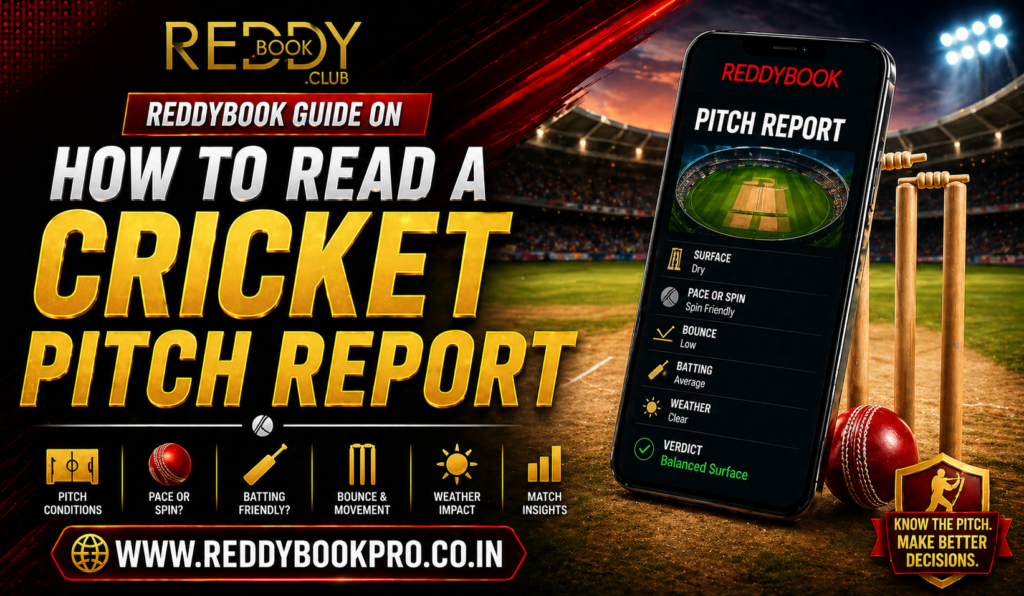
Understanding a cricket match starts long before the first ball is bowled. One of the most important factors that decides how a game unfolds is the pitch. For users on Reddybook, reading a pitch report correctly can completely change how you understand a match, its direction, and key turning points.
This guide explains in detail how to read a cricket pitch report like an expert, what to look for, and how to connect it with real match situations.
Why Pitch Report Matters More Than You Think
Many beginners focus only on teams and players, but experienced users know that the pitch often controls the game.
A good pitch report tells you:
- How easy or difficult batting will be
- Whether bowlers will get help
- How the match might progress over time
For example, a flat pitch may lead to a high-scoring game, while a slow surface may result in a low-scoring contest. On Reddybook, understanding this early gives you a clear advantage in reading match flow.
What is a Cricket Pitch Report?
A pitch report is an analysis of the playing surface before the match begins. It is usually shared by commentators or experts just before the toss.
It includes observations like:
- Surface condition (dry, grassy, hard)
- Expected behavior of the pitch
- Past match patterns at the venue
This report is your first real clue about how the match might behave.
Types of Cricket Pitches and Their Behavior
Not all pitches are the same. Each type behaves differently and affects players in unique ways.
A flat pitch is usually hard and even, making it easier for batters to play shots. These matches often see high scores and fast run rates.
A dry or dusty pitch tends to assist spin bowlers. The ball may turn more, especially in the second innings, making batting difficult.
A green pitch has grass on it and supports fast bowlers. The ball may swing or seam, especially early in the match.
Understanding these basic types helps you quickly interpret any pitch report.
How Pitch Changes During the Match
A pitch does not remain the same throughout the game. Its behavior changes as the match progresses.
In many cases:
- Early overs may favor bowlers
- Middle overs become balanced
- Later stages may favor batters or spinners depending on wear
In T20 matches, these changes happen quickly. Observing how the pitch reacts in the first few overs gives valuable insight.
For Reddy book users, this is where real understanding begins—connecting the pitch report with actual match behavior.
Reading Pitch Report Before Toss
Before the toss, the pitch report gives a basic idea of what to expect. However, it is not final until you see how teams respond to it.
For example:
- If the pitch looks slow, teams may prefer batting first
- If conditions favor chasing, teams may choose to bowl
Instead of relying only on the report, combine it with toss decisions to get a clearer picture.
Toss + Pitch = Real Match Direction
The toss becomes much more meaningful when combined with the pitch report.
A dry pitch with spin assistance usually favors the team batting first, as batting becomes harder later. On the other hand, a fresh pitch with dew conditions may favor chasing.
On Reddybook, this combination helps you understand which team has a slight advantage before the match even begins.
Key Signs to Look for in a Pitch Report
When you hear or read a pitch report, focus on specific details instead of general comments.
Look for:
- Cracks or dryness on the surface
- Grass covering
- Hardness of the pitch
- Previous match behavior at the venue
These small details often reveal more than general statements.
How to Connect Pitch Report with Player Performance
The pitch directly affects how players perform. A good understanding helps you predict which players may have an impact.
On a flat pitch, aggressive batters often dominate. On a slow pitch, spinners and controlled batters perform better.
Instead of focusing only on big names, match player strengths with pitch conditions. This gives you a clearer understanding of match dynamics.
Live Observation After Pitch Report
The pitch report gives a starting point, but real confirmation comes from the first few overs of the match.
Watch:
- How the ball is coming onto the bat
- Whether bowlers are getting movement
- How easily runs are being scored
If the actual behavior matches the report, you can rely on it more confidently. If not, adjust your understanding accordingly.
Common Mistakes While Reading Pitch Reports
Many users misinterpret pitch reports because they focus only on keywords instead of overall context.
Some common mistakes include:
- Assuming every dry pitch will be low scoring
- Ignoring weather conditions
- Not observing actual match behavior
- Overreacting to early overs
Avoiding these mistakes helps you develop a more accurate reading.
Venue History and Pitch Patterns
Every stadium has its own pattern. Some venues consistently produce high scores, while others are known for slower games.
Looking at past matches at the same venue helps you understand:
- Average scores
- Batting vs bowling advantage
- Match trends
On Reddybook, combining venue history with pitch report improves your match understanding.
How Experts Read Pitch Reports Differently
Experienced users don’t just listen to the pitch report—they analyze it.
They:
- Compare report with past matches
- Observe team strategies
- Watch early match behavior
This layered approach gives a more accurate picture instead of relying on one factor.
How Reddybook Users Can Use Pitch Reports Smartly
On Reddybook, pitch understanding plays a major role in reading match situations.
Instead of reacting quickly:
- Observe pitch report carefully
- Watch first few overs
- Connect conditions with player performance
This helps you stay ahead and understand match flow better.
A cricket pitch report is not just a pre-match formality—it is one of the most important tools for understanding a game. When used correctly, it gives you a strong foundation to read match situations.
For Reddybook users, combining pitch reports with live observation, player form, and match conditions creates a complete understanding.


 Get Reddy Anna ID Now